Resistance bands offer a surprisingly effective method for chest training, proving you don’t need heavy weights for muscle activation and gains.
These versatile tools are compact, affordable, and perfect for workouts anywhere, challenging the notion that bulk is essential for building strength.
What are Resistance Bands?
Resistance bands are elastic bands used for strength training, providing variable resistance throughout a range of motion. Unlike traditional weights, they don’t rely on gravity, offering consistent tension. They come in various materials, primarily latex or rubber, and differing resistance levels, often color-coded for easy identification.
These bands aren’t just for rehabilitation; they’re a powerful tool for building muscle, improving endurance, and enhancing flexibility. Their portability makes them ideal for home workouts, travel, or supplementing gym routines. They’re a highly functional piece of kit, offering a surprising level of challenge and versatility for all fitness levels.
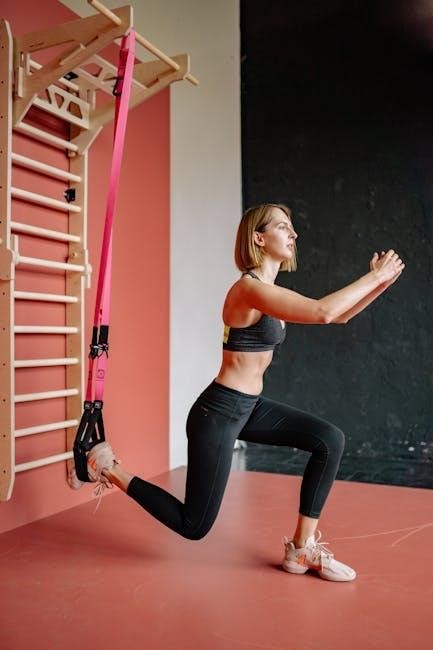
Essentially, resistance bands provide a safe and effective way to engage muscles, making them a valuable asset in any fitness regimen.
Why Choose Resistance Bands for Chest Workouts?

Resistance bands present a compelling alternative to dumbbells or machines for chest exercises, offering unique advantages. They’re incredibly portable and convenient, allowing effective workouts anywhere without needing a gym membership or bulky equipment. This makes them perfect for travel or home fitness.
Furthermore, they are remarkably cost-effective, significantly cheaper than traditional weights. Bands also provide a unique challenge by maintaining tension throughout the entire exercise, potentially leading to increased muscle activation. You don’t need heavy weights to stimulate chest muscle growth!
They’re also a great option for beginners, offering a gentler introduction to strength training, and adaptable for all fitness levels.

Benefits of Resistance Band Chest Training
Resistance band training delivers increased muscle activation, portability for workouts anywhere, and cost savings compared to traditional weights and gym equipment.
Increased Muscle Activation
Resistance bands uniquely challenge muscles throughout the entire range of motion, unlike traditional weights which can have ‘sticking points’. The constant tension provided by the bands forces your chest muscles to work harder and more consistently during each exercise.
This sustained engagement leads to greater muscle fiber recruitment, ultimately enhancing strength and promoting hypertrophy. Bands don’t allow for momentum, demanding focused muscular effort. They are surprisingly effective at delivering the chest muscle activation you seek, even without bulky dumbbells.
This makes them an excellent tool for building a well-defined and powerful chest, proving that gains aren’t solely dependent on lifting heavy loads.
Portability and Convenience
Resistance bands excel in portability, being incredibly compact and lightweight – easily packed for travel or workouts outside the gym. Unlike dumbbells or machines, they require minimal space, making them ideal for home workouts or limited environments.
This convenience removes barriers to exercise, allowing you to maintain your chest training routine wherever life takes you. They are a fantastic option for those who travel frequently or prefer the flexibility of working out on their own schedule.
You can get a good full-body workout, including effective chest exercises, without needing a dedicated gym space or expensive equipment.
Cost-Effectiveness
Resistance bands present a remarkably cost-effective alternative to traditional weightlifting equipment. A full set of quality bands is significantly cheaper than dumbbells, weight plates, or a gym membership, making fitness accessible to a wider range of individuals.
This affordability doesn’t compromise effectiveness; bands provide variable resistance for a challenging chest workout. They eliminate the need for expensive gym contracts or constantly upgrading your home gym setup.
For those starting their fitness journey or seeking a budget-friendly option, resistance bands are an excellent investment, delivering substantial value for your money.

Essential Resistance Band Types for Chest Exercises
Resistance bands come in various forms, primarily tube and loop bands, each offering unique benefits for chest workouts and exercise versatility.
Different Resistance Levels
Resistance bands aren’t one-size-fits-all; they come with varying resistance levels, typically color-coded for easy identification. Beginners should start with lighter resistance, focusing on proper form before increasing the challenge.
As you grow stronger, progressively increase the resistance to continue stimulating muscle growth and preventing plateaus. A good set will include light, medium, and heavy bands, allowing for exercise modification and progression.
Choosing the correct resistance is crucial; too light won’t provide enough stimulus, while too heavy can compromise form and increase injury risk. Experiment to find what feels challenging yet manageable for each exercise, ensuring full range of motion.
Tube Bands vs. Loop Bands
Resistance bands primarily come in two forms: tube bands with handles and loop bands (also called mini-bands). Tube bands are ideal for chest exercises requiring a wider range of motion and a secure grip, like chest presses and flyes.
Their handles provide comfort and control, making them versatile for various movements. Loop bands, smaller in circumference, are excellent for activation and stabilization exercises, often used around the wrists or upper arms.
For chest workouts, tube bands generally offer more functionality, allowing for effective simulation of traditional weightlifting exercises. However, combining both types can enhance your routine, targeting different muscle fibers and improving overall chest development.

Top 10 Resistance Band Chest Exercises
Discover ten effective exercises utilizing resistance bands to target your chest muscles, offering a versatile and accessible workout for all fitness levels.
Resistance Band Chest Press
The Resistance Band Chest Press is a fantastic alternative to the traditional barbell or dumbbell chest press, offering a similar muscle engagement with adjustable resistance. Securely anchor the band behind you, at chest height, or use a sturdy door anchor. Lie on your back with knees bent and feet flat on the floor, holding the band ends.
Extend your arms upwards, pressing the band away from your chest as if performing a standard chest press. Focus on squeezing your chest muscles at the peak of the movement. Slowly lower the band back to the starting position, maintaining control throughout. This exercise effectively targets the pectoralis major, building strength and definition. Adjust band tension to modify difficulty.
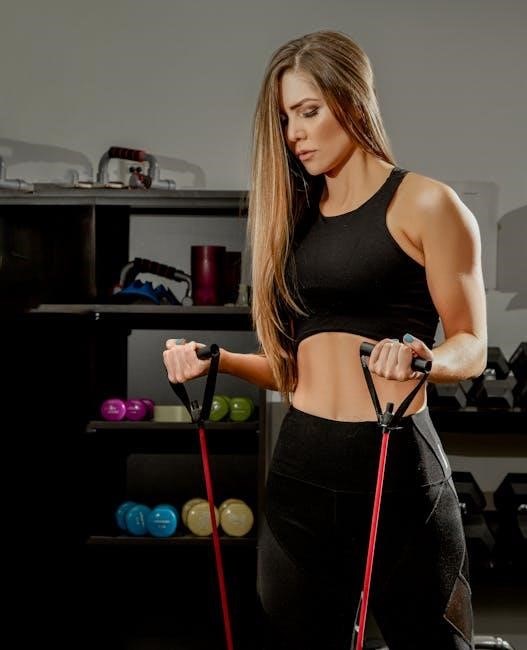
Resistance Band Flyes
Resistance Band Flyes effectively isolate the chest muscles, promoting a wider and more defined pectoral appearance. Secure the band around a stable anchor point at chest height. Lie on your back with knees bent and feet flat, holding one end of the band in each hand.
With a slight bend in your elbows, slowly open your arms out to the sides, maintaining constant tension on the band. Focus on feeling a stretch in your chest as you lower your arms. Bring your arms back to the starting position in a controlled arc, squeezing your chest muscles together. This exercise enhances chest width and improves muscle definition. Adjust band resistance for optimal challenge.
Resistance Band Pullovers
Resistance Band Pullovers are a fantastic exercise targeting the chest, lats, and serratus anterior, contributing to overall upper body development. Secure the band overhead, anchoring it firmly. Lie on your back, perpendicular to the anchor point, with your knees bent and feet flat on the floor.
Hold the band with both hands, arms extended towards the ceiling. Slowly lower your arms back behind your head, keeping a slight bend in your elbows, feeling a stretch across your chest and lats. Pull your arms back to the starting position, focusing on contracting your chest and back muscles. This movement improves posture and enhances upper body strength.
Resistance Band Push-Ups
Resistance Band Push-Ups elevate the classic exercise, adding intensity and challenge to your chest, shoulders, and triceps. Loop the resistance band across your upper back, holding the ends under your hands. Assume a standard push-up position with hands shoulder-width apart, maintaining a straight line from head to heels.
Lower your body towards the floor, keeping your core engaged and elbows slightly tucked. The band increases resistance throughout the movement, demanding greater muscle activation. Push back up to the starting position, focusing on controlled movements and full range of motion. This variation builds strength and endurance effectively.
Resistance Band Single Arm Chest Press
Resistance Band Single Arm Chest Press isolates each pectoral muscle for focused development. Securely anchor the resistance band at chest height, ensuring a stable base. Lie on your back with knees bent and feet flat on the floor, holding one end of the band in your hand.
Extend your arm straight up towards the ceiling, pressing against the band’s resistance. Slowly lower your arm back to the starting position, maintaining control throughout the movement. This exercise enhances unilateral strength and addresses muscle imbalances. Repeat on the opposite side for a balanced chest workout, focusing on proper form.
Resistance Band Chest Rotation
Resistance Band Chest Rotation dynamically engages the pectoral muscles while improving rotational strength and stability. Anchor the band at chest height, standing with feet shoulder-width apart and a slight bend in your knees. Hold the band with both hands, palms facing each other, and arms extended forward.
Maintaining a controlled motion, rotate your torso from side to side, keeping your arms extended and resisting the band’s pull. Focus on squeezing your chest muscles during the rotation. This exercise enhances core engagement and adds a unique challenge to traditional chest workouts, promoting functional strength.
Resistance Band Incline Chest Press
Resistance Band Incline Chest Press targets the upper pectoral muscles, contributing to a fuller, more developed chest. Securely anchor the band behind you at an incline – using a sturdy object or door anchor. Lie on an incline bench or a stable elevated surface, holding the band ends with palms facing forward.
Press the band upwards, extending your arms as if performing a traditional incline press, focusing on squeezing your chest at the top of the movement. Slowly lower the band back to the starting position, maintaining control throughout. This variation effectively builds upper chest strength and definition.
Resistance Band Decline Chest Press
Resistance Band Decline Chest Press effectively works the lower pectoral muscles, enhancing overall chest development and providing a unique stimulus. Anchor the resistance band securely above you, utilizing a stable structure or a specialized decline bench setup. Lie on a decline bench, grasping the band ends with palms facing forward.
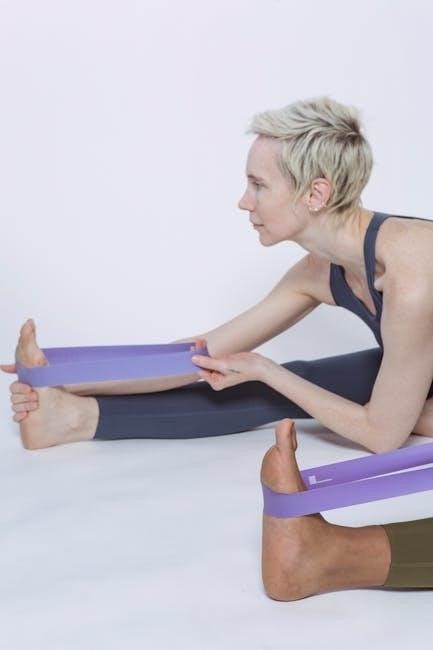
Press the band upwards, extending your arms as if performing a standard decline press, concentrating on contracting your chest muscles during the exertion phase. Gradually lower the band back to the initial position, maintaining consistent tension. This exercise is excellent for sculpting a well-rounded chest physique.
Resistance Band Cross-Body Chest Press
Resistance Band Cross-Body Chest Press is a dynamic exercise targeting the chest muscles with a rotational component, enhancing muscle activation and functional strength. Secure the resistance band to a stable anchor point at chest height. Stand with feet shoulder-width apart, holding the band with one hand extended across your body, towards the opposite shoulder.
Press forward, extending your arm while maintaining a slight bend in the elbow, focusing on squeezing your chest. Slowly return to the starting position, controlling the band’s resistance. Repeat on the other side, alternating arms for a balanced workout. This variation adds a unique challenge.
Resistance Band Chest Squeeze
Resistance Band Chest Squeeze is an isolation exercise specifically designed to target the inner pectoral muscles, promoting definition and strength. Sit comfortably with your back supported, or stand with good posture. Wrap a resistance band around your upper back, holding one end in each hand, palms facing each other.
Bring your hands together in front of your chest, squeezing your pectoral muscles as you adduct your arms. Focus on maintaining a controlled movement throughout the exercise, resisting the band’s pull. Slowly return to the starting position, allowing the band to assist the movement.

Creating a Resistance Band Chest Workout Routine
Designing a routine involves a proper warm-up, structured sets and repetitions, and progressive overload to continually challenge your chest muscles for optimal growth.
Warm-up Exercises
Prior to initiating your resistance band chest workout, a dynamic warm-up is crucial for preparing your muscles and joints, minimizing injury risk, and maximizing performance. Begin with five minutes of light cardio, such as jumping jacks or high knees, to elevate your heart rate and increase blood flow.
Follow this with dynamic stretches specifically targeting the chest, shoulders, and triceps. Arm circles – both forward and backward – are excellent for shoulder mobility. Chest stretches, performed by clasping your hands behind your back and gently extending your arms, open up the pectoral muscles.
Band pull-aparts, using a light resistance band, further activate the rear deltoids and upper back, promoting proper posture during chest exercises. Include shoulder rotations and tricep stretches to ensure comprehensive preparation. A well-executed warm-up will significantly enhance your workout’s effectiveness and safety.
Workout Structure (Sets & Reps)
For optimal results with your resistance band chest routine, a structured approach to sets and repetitions is essential. Aim for 3-4 sets of each exercise, focusing on controlled movements throughout. The ideal rep range will depend on your fitness goals; for muscle hypertrophy (growth), target 8-12 repetitions per set.
If your primary goal is muscular endurance, increase the reps to 15-20. Rest periods between sets should be between 60-90 seconds to allow for partial recovery while maintaining workout intensity.
Progressive overload is key – gradually increase the resistance band level or the number of repetitions as you get stronger. Listen to your body and adjust the volume accordingly. Remember to prioritize proper form over lifting heavier resistance, ensuring a safe and effective workout.
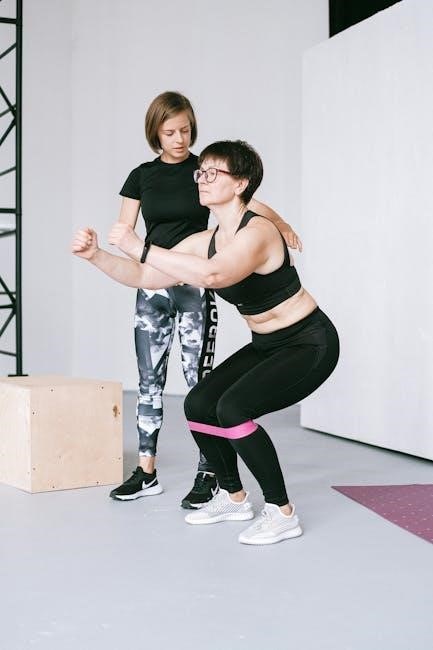
Safety Considerations & Proper Form
Prioritize safety by selecting appropriate resistance and securely anchoring bands. Maintaining correct form prevents injuries and maximizes chest muscle engagement during exercises.
Choosing the Right Resistance Level
Selecting the correct resistance is crucial for both effectiveness and safety when performing resistance band chest exercises. Beginners should start with lighter bands, focusing on mastering proper form before increasing the challenge. A good indicator is being able to complete 10-12 repetitions with controlled movements.
As you grow stronger, progressively increase the resistance by either switching to a heavier band or doubling up bands. The goal is to find a level that challenges your muscles without compromising your technique. If you struggle to maintain form, or experience pain, reduce the resistance immediately. Remember, consistent, controlled movements are far more beneficial than struggling with a band that’s too heavy.
Consider a variety pack to accommodate different exercises and progression levels.
Anchoring the Bands Securely
Proper anchoring is paramount for safety and maximizing the effectiveness of resistance band chest exercises. Always inspect bands for any tears or damage before each use, discarding compromised bands immediately. When anchoring to a stable object, ensure it’s robust enough to withstand the force generated during the exercise – a sturdy door frame or heavy furniture leg are good options.
Utilize door anchors designed for resistance bands, ensuring they are correctly installed and securely closed. For exercises without a fixed anchor point, maintain a firm grip on the band ends, and be mindful of potential snap-back if the band breaks. Prioritize a stable base and controlled movements throughout each repetition to minimize risk.
Never anchor to unstable surfaces!